 Scaley
Pay per Click Advertising Platforms for Stores
PPC advertising platforms compared for online stores: Google Ads, Microsoft, Amazon, Meta and more. Who each one fits, what clicks cost, and where to start.

Written and reviewed by Christopher Krassnig
Published Last checked
Pay per click advertising platforms are the ad networks where you pay when someone clicks: Google Ads, Microsoft Advertising, Amazon Ads, Meta, TikTok and Pinterest are the ones a store will meet. For most online stores, Google Ads with a Shopping or Performance Max campaign comes first. It puts your product, photo and price in front of people already searching for it.
I run ZenoX Media, a Google Ads agency, and I founded Scaley, a Google Ads tool. So I lean Google. Where that is the wrong call for you, I will say so.
Pay Per Click Advertising Platforms at a Glance
| Platform | Where your ad shows | Who it fits | How you pay |
|---|---|---|---|
| Google Ads | Google Search, Shopping, YouTube, Gmail, Discover, Maps | Any store people already search for | Mostly per click |
| Microsoft Advertising | Bing and Microsoft's search network | Stores already profitable on Google | Mostly per click |
| Amazon Ads | Amazon search results, product pages and beyond | Brands selling on Amazon | Per click (Sponsored Products) |
| Meta (Facebook and Instagram) | Feeds, Stories, Reels | New products nobody searches for yet | Per impression or per click, by objective |
| TikTok | The For You feed | Visual products with a hook | By objective |
| Pins and Pinterest search | Home, fashion, gifts, things people plan | By objective | |
| LinkedIn feed and inbox | B2B, not stores | By objective |
Two kinds of platform sit in that table. Search platforms (Google, Microsoft, Amazon) catch people who already want something. Feed platforms (Meta, TikTok, Pinterest) put your product in front of people who were not looking.
What a Click Costs on Each Platform
| Platform and segment | Average cost per click | Source |
|---|---|---|
| Search ads, all industries | $5.42 | LocaliQ, search benchmarks, 2026 |
| Search ads, Apparel, Fashion and Jewelry | $4.44 | LocaliQ, 2026 |
| Search ads, Shopping, Collectibles and Gifts | $4.14 | LocaliQ, 2026 |
| Search ads, Beauty and Personal Care | $4.62 | LocaliQ, 2026 |
| Search ads, Home and Home Improvement | $8.33 | LocaliQ, 2026 |
| Facebook ads, traffic campaigns, all industries | $0.60 | LocaliQ, Facebook benchmarks, 2026 |
| Facebook ads, leads campaigns, all industries | $1.80 | LocaliQ, 2026 |
| Amazon Sponsored Products | No official average | Amazon does not publish one |
| Microsoft Advertising alone | No clean public number | LocaliQ blends it into the search figure |
The Search Numbers Mix Google and Microsoft
LocaliQ says its search benchmark comes from thousands of customer campaigns "across Google Ads and Microsoft Ads". I found no Microsoft-only number with a method I would trust, so I am not printing one.
A Facebook Click Is Not a Google Click
$0.60 looks like a steal next to $5.42. But the person behind a search click typed what they want. The person behind a Facebook click was scrolling past their cousin's holiday photos. The click is cheaper because the buyer is colder.
Your CPC Is Your Own
On Google you pay what it takes to beat the ad below you, and better ads and pages lower that price. How Google sets your CPC walks through it.
The number that matters is cost per sale against your margin. Work out what you can afford per click with our CPC calculator. It is profit per sale times conversion rate. $40 profit and 2 sales per 100 clicks means you can pay up to $0.80 a click.
Google Ads: Where Most Stores Should Start
A Shopping ad shows the product, photo and price to someone searching for it. Google's help page puts it as "a product photo, title, price, store name, and more". On billing it says: "You're charged using cost-per-click (CPC)."
The campaign types a store uses:
- Shopping. Product listings built from your Merchant Center feed. What Google Shopping ads are.
- Performance Max. One campaign across Search, Shopping, YouTube and more, built from the same feed. What Performance Max is.
- Search. Text ads. For a store, mostly your own brand name.
One more reason to start here: the feed you build for Google Shopping also gets you free listings. Google says your products can appear "at no cost on Google Search, Google Maps, Gemini, YouTube", plus the Shopping tab, Images and Lens. Paid and free run off the same feed.
Google is the wrong first platform in one case: nobody searches for your product yet. More on that below.
The full build order, feed first, is in Google Ads for ecommerce. The budget rules are in how much Google Ads costs.
Microsoft Advertising: The Cheap Second Step
Microsoft Advertising runs ads on Bing and Microsoft's search network. Same idea as Google: people search, you bid, you pay per click.
The reason it is an easy second platform: you can copy Google over. Microsoft's own docs say, "If you already are using Google Ads to advertise on Google, you can import these campaigns into Microsoft Advertising and run the same ads on Bing." You can even schedule the import to repeat, daily, weekly or monthly.
Two catches. Microsoft also says "not all information will be imported", so check every campaign by hand after the import. And in my experience Bing sends fewer searches than Google, so expect fewer sales, not the same sales cheaper.
When to add it: once Google makes money. Not before. A broken Google account copied to Bing is two broken accounts.
Amazon Ads: Only If You Sell on Amazon
Amazon's Sponsored Products are "cost-per-click (CPC) ads that promote individual product listings". Amazon says they may show "at the top of, alongside, or within shopping results and on product pages". There are "no monthly or upfront fees".
The catch is in who can use them: professional sellers, vendors and book vendors, and Amazon says products "must be in one or more eligible categories and be eligible for the Featured Offer". In plain words, your product has to be sold on Amazon.
So for a Shopify store that does not sell on Amazon, Amazon Ads is not an option. For a brand that does, it is often the strongest search platform after Google, because people on Amazon are already shopping.
Amazon publishes no average CPC on its Sponsored Products page. Third-party blogs throw around numbers, but the methods are unclear, so I am leaving them out. Your campaign manager shows you real bids for your own keywords.
Meta, TikTok and Pinterest: When Nobody Is Searching Yet
These are feed platforms. You pay to show your product to people who fit a profile, not to people typing a search.
That makes them the right call in a few cases:
- A new product nobody knows exists. If there is no search volume, Google has nothing to catch. Meta and TikTok are better at making someone want a thing they never looked for.
- A product that sells on looks or a demo. A 10-second video does what a Shopping listing cannot.
- Pinterest for things people plan. Home, weddings, outfits, gifts.
So the LocaliQ click prices above are not a like-for-like race. In my experience at ZenoX, a store often does best with both: the feed platform makes people want the product, and Google catches them when they search for it later.
If you are deciding between the two big ones, read Google Ads vs Facebook Ads. And if you are wondering about the newest one, ChatGPT ads covers what OpenAI sells today.
Which Platform for PPC First: A Simple Order
This is the order we use with new store accounts at ZenoX Media. We have run Google Ads for 400+ store accounts, so take it as one agency's habit, not a law.
- Work out your break-even ROAS first. 1 divided by your gross margin. 40% margin means 2.5x. The break-even ROAS calculator does it for you.
- Do people search for your product? Type it into Google. If you see Shopping ads from rivals, the demand exists. Start with Google Shopping or Performance Max.
- No search demand? Start on Meta or TikTok. Come back to Google once people start searching for your product or brand name.
- Selling on Amazon? Add Sponsored Products for your best sellers.
- Google profitable for a few months? Import it to Microsoft Advertising and judge it on its own numbers.
- One new platform at a time. Each one needs its own budget, its own tracking and its own learning time. Spread a small budget over three new platforms and none of them gets enough data to tell you anything.
The math and the weekly routine behind step 1 and step 2 are in how to do PPC marketing. The bigger decisions, like budget and bidding, are in our PPC strategy guide.
Pick the platform where your buyer already looks. Then make it pay before you add the next one.
- The rule I use
Tools for Managing More Than One PPC Platform
Every platform has its own dashboard, and most tools only cover one or two. Two multi-platform options, going by their own websites: Adzooma says it works "across Google, Microsoft, and Facebook", and Optmyzr names Google, Microsoft, Amazon, Meta, LinkedIn and TikTok Ads. We compared both with Scaley in Scaley vs Adzooma, Adzooma alternatives and the Optmyzr alternative. If you run ads on three or more platforms, a tool like that can save you a lot of tab switching. Our ranking of Google Ads automation tools shows which tool does which job.
What Scaley Does for Google Ads
Scaley only covers Google Ads. If most of your money sits on Meta or Amazon, it is not your tool. Use one built for that platform, or your own store numbers.
If Google is your main platform, this is what Scaley does:
- Scaley Media Buyer connects to your Google Ads account read-only. Ask where money leaks and you see the waste right away. It never changes anything and never scans on its own.
- Scaley Suite finds the fixes and makes each change only after you say yes to that one change.
- Scaley Consultant answers from your screenshots and CSV exports. Nothing gets connected.
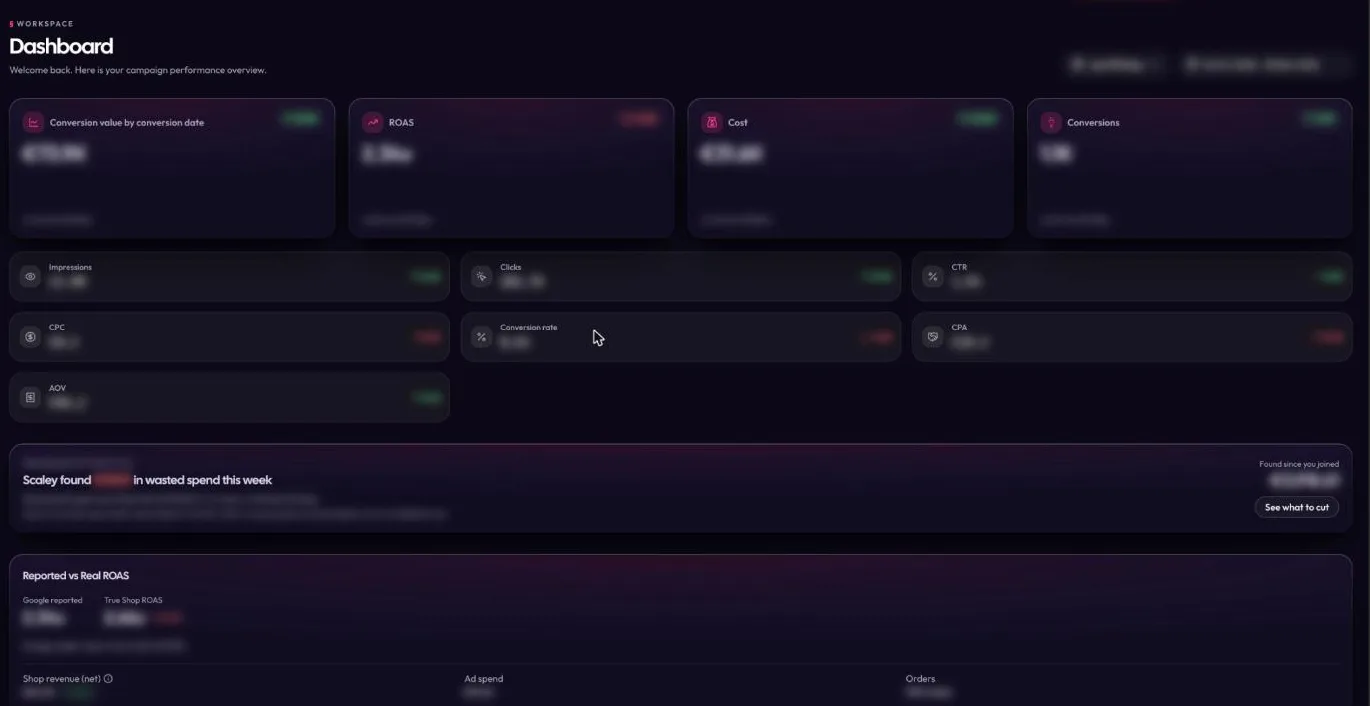
Start with Media Buyer. Start the free trial and ask Scaley what your account wasted this week. Card required, cancel any day. All three tiers and prices are on the pricing page.
Where These Facts Come From
Checked on 2026-11-03:
- Search Advertising Benchmarks for Every Industry, 2026 Data, LocaliQ - last updated June 1, 2026. The $5.42 all-industry search CPC, the industry CPCs, and the data coming from campaigns "across Google Ads and Microsoft Ads". The page states no exact data window.
- Facebook Advertising Benchmarks for 2026, LocaliQ - last updated September 23, 2026. The $0.60 traffic CPC and $1.80 leads CPC, all industries combined. The page states no exact data window.
- About Shopping ads, Google Ads Help - what a Shopping ad shows and the cost-per-click charge.
- Free listings for products, Google Merchant Center Help - where free product listings show, at no cost.
- Google Ads Import, Microsoft Learn - importing Google Ads campaigns into Microsoft Advertising, scheduled imports, and the note that not all information is imported.
- Optmyzr homepage - the list of ad platforms it says it supports.
- Adzooma homepage - "Optimise PPC campaigns across Google, Microsoft, and Facebook".
- Sponsored Products, Amazon Ads - the CPC model, placements, no upfront fees, and who is eligible.
The break-even CPC and break-even ROAS math is arithmetic you can redo with your own numbers.
Frequently Asked Questions
I founded Scaley AI and run ZenoX Media, the Google Ads agency behind it. We have $200M+ in client revenue tracked through our campaigns, across 400+ store accounts. Scaley Media Buyer puts those answers in a chat.
See where Scaley would cut waste on your Google Ads
Connect read-only in under five minutes and ask where the money went. Every level starts with a 3-day free trial. Card required. Cancel anytime.
Start the 3-Day Free TrialMore Worth Reading
Pay per Click Advertising: How to Do PPC Marketing for a Store
Pay per click advertising explained: how Google Ads works, the campaign types, the break-even math, and how to do PPC marketing for a store, step by step.
ReadBest AI for Google Ads in 2026, Sorted by What It Can Touch
The best AI for Google Ads depends on the job. We sort Google Ads AI tools, from ChatGPT and Claude to Optmyzr, Ryze, groas and Scaley, by what each can touch.
ReadPerformance Max vs Standard Shopping
Performance Max vs Standard Shopping for online stores: control, search terms, budget and results side by side, and when to run both at the same time.
Read